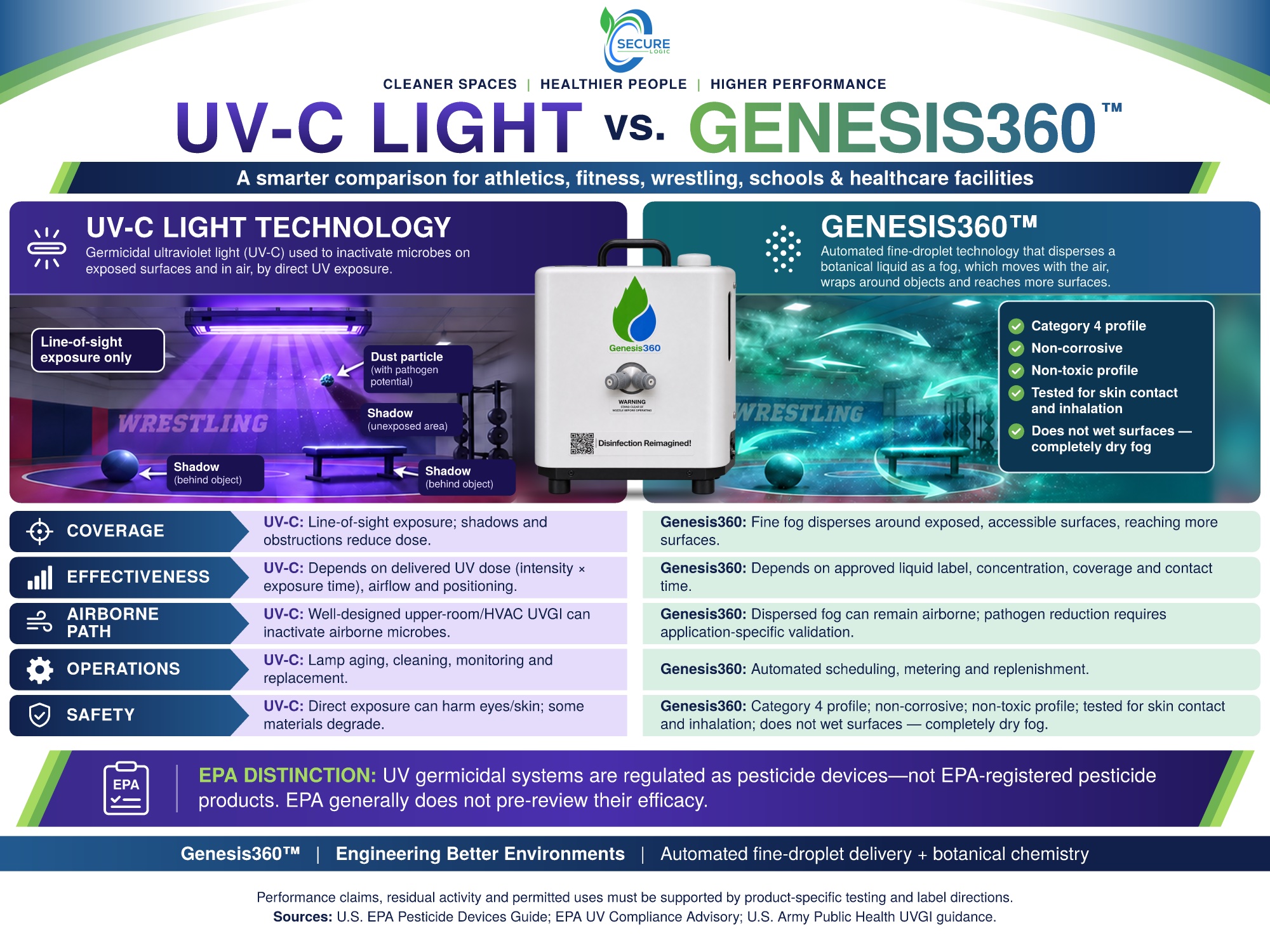
If you run a gym, a wrestling room, a school or a clinic, someone has probably pitched you a UV light. The idea is easy to like: mount a purple lamp, flip a switch, and germs disappear. No chemicals, no labor.
UV-C light does work, under the right conditions. But those conditions are narrower than most people realize, and the reason comes down to something everyone already understands: shadows.
How UV-C Light Works
Germicidal UV-C is a type of ultraviolet light that damages microbes when it shines directly on them. The key word is directly. UV is light, and light travels in straight lines. It only treats what it can see.
That gives every UV system two requirements:
- Line of sight. The light has to reach the surface or the particle with nothing in the way.
- Enough exposure time. The dose depends on how strong the light is multiplied by how long it shines. A quick pass isn't the same as a full treatment.
The Shadows You Can See
Picture a wrestling room with a UV lamp on the ceiling. The light pours down onto the mats. Now look at what's in the room: benches, a weight rack, exercise balls, gear bags. Every one of them casts a shadow. Under the bench, behind the rack, on the far side of the ball: the light never gets there.
Those are exactly the places people touch, sit, kneel and drop their things. A UV lamp can light the open floor beautifully and still leave the corners and undersides of a room untouched.
The Shadows You Can't See
Here's the part that rarely comes up in a sales pitch. The shadows that matter most are microscopic.
The air in any room is full of dust: skin cells, fibers, pollen, dirt tracked in on shoes. Watch a kid drop a backpack on a classroom floor and, if you could zoom in, you'd see a plume of dust rise into the air. Swap an air filter, shuffle across a mat, open a window, and the same thing happens.
Bacteria and viruses are far smaller than those dust particles, and they ride on them. To a microbe, a speck of dust is the size of a boulder. When UV light hits that dust particle, it lights up one side. Anything sitting on the far side is in the particle's own shadow, and the light never touches it.
Now add movement. That dust isn't sitting still under the lamp. It's drifting through the air, carried by fans, HVAC and people walking by. It passes through the beam in a moment. Think of a jackhammer on concrete: one hit only chips the surface. It takes steady, repeated pounding to break through. A particle floating past a UV lamp gets one brief, one-sided hit.
A Different Approach: Go Around, Not Through
Genesis360 works on a different principle. Instead of shining light across a room, it disperses a botanical liquid as an extremely fine fog. The droplets are so small they behave less like a spray and more like the air itself.
That changes what's reachable:
- Fog has no shadows. It moves with the air, so it travels under benches, behind racks and around equipment instead of stopping at the first object in its path.
- It surrounds, not just strikes. Fine droplets wrap around objects and particles on every side, including the side a UV lamp would leave in the dark.
- It's dry. The fog doesn't leave surfaces wet, so a room can be treated without soaking mats, electronics or equipment.
Back in that classroom, imagine the dust plume rising from the backpack. With UV, a few particles drift through a beam of light. With Genesis360, the room is filled with droplets far smaller than the dust, and they surround it wherever it goes.
Side by Side
- Coverage. UV-C relies on line-of-sight exposure, and shadows and obstructions reduce the dose. Genesis360's fine fog disperses around exposed, accessible surfaces, reaching more of the room.
- Effectiveness. UV-C depends on delivered dose (intensity × time), airflow and lamp position. Genesis360 depends on the approved liquid label, concentration, coverage and contact time.
- The air. Well-designed upper-room or HVAC UV systems can treat air that passes through them. Genesis360's dispersed fog can remain airborne and move through the space itself.
- Day-to-day operation. UV lamps age, need cleaning, monitoring and replacement. Genesis360 runs on automated scheduling, metering and replenishment.
- Safety. Direct UV-C exposure can harm eyes and skin, and some materials break down under it. Genesis360 uses a botanical liquid with a Category 4, non-corrosive, non-toxic profile, tested for skin contact and inhalation.
One More Thing: How They're Regulated
Many buyers assume a UV light has been through the same EPA review as a registered disinfectant. It hasn't. The EPA treats UV germicidal systems as pesticide devices, not registered pesticide products, and it generally does not review their effectiveness before they're sold. Liquids used for disinfection go through product registration, with labels that spell out how they must be used.
The Bottom Line
UV-C light isn't useless. It just has a blind spot built into how light works. It can only treat what it can see, for as long as it can see it, and in a real room, full of equipment and moving dust, that leaves a lot in the dark.
If your facility needs coverage that goes around corners, under benches and onto every side of what's floating in the air, it's worth looking at a technology that doesn't cast shadows.
See how Genesis360 works, or get a quote for your facility.
Sources: U.S. EPA Pesticide Devices Guide; EPA UV Compliance Advisory; U.S. Army Public Health UVGI guidance.